

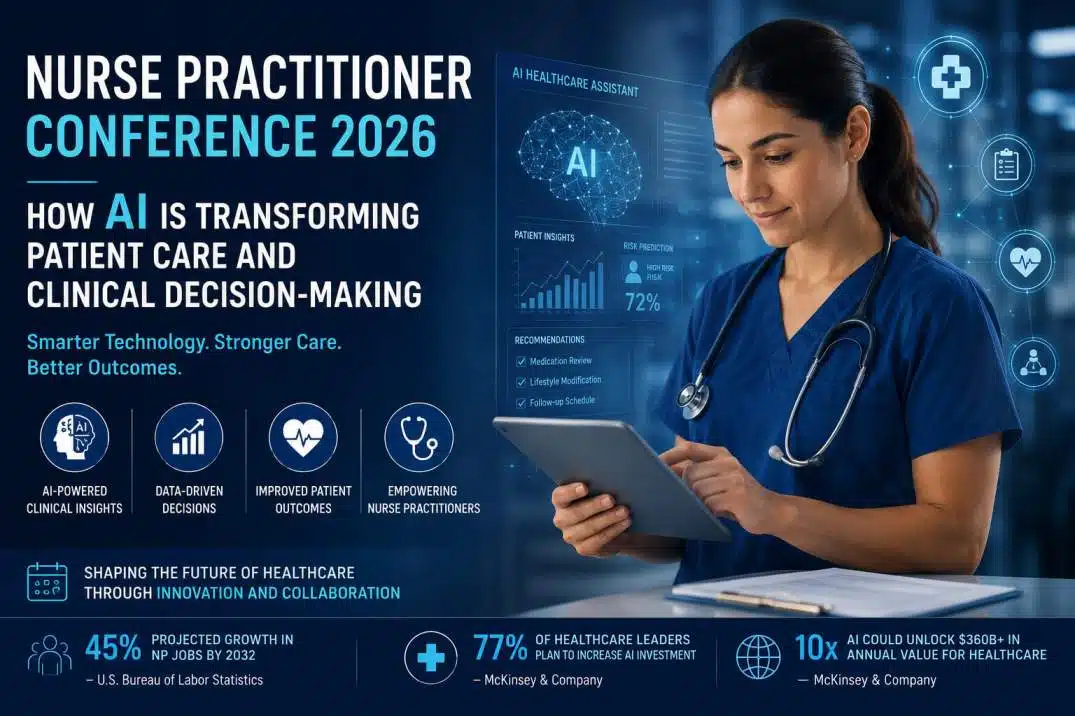
Nurse Practitioner Conference 2026 is expected to spotlight one of the most significant healthcare transformations of our time: the integration of artificial intelligence (AI) into patient care and clinical decision-making. From predictive analytics and diagnostic support systems to remote patient monitoring and personalized treatment planning, AI is reshaping healthcare delivery at an unprecedented pace.
Healthcare organizations worldwide are facing growing challenges, including physician shortages, increasing patient volumes, rising chronic disease prevalence, administrative burdens, and escalating healthcare costs. According to the World Health Organization (WHO), healthcare workforce shortages remain one of the most pressing global health concerns, while the demand for healthcare services continues to increase due to aging populations and longer life expectancy.
In response, healthcare providers are increasingly turning to AI-powered technologies to improve efficiency, enhance patient outcomes, and support clinical decision-making. Nurse practitioners (NPs), who play a critical role in modern healthcare systems, are becoming some of the most important users of these technologies.
As AI adoption accelerates, nurse practitioners must understand how emerging technologies are influencing diagnosis, treatment, patient engagement, workflow optimization, and healthcare accessibility. This article explores how AI is transforming patient care, the growing role of nurse practitioners in AI-driven healthcare, emerging industry trends, ethical considerations, and what healthcare professionals can expect in the years ahead.
Why AI Adoption Is Accelerating in Healthcare
Artificial intelligence has moved beyond experimentation and is now becoming a practical tool in everyday healthcare operations.
Several factors are driving this rapid adoption:
- Increasing healthcare demand
- Workforce shortages
- Rising healthcare costs
- Administrative inefficiencies
- Growing volumes of patient data
- Advances in computing power and machine learning
Healthcare organizations generate enormous amounts of clinical information every day. Electronic health records (EHRs), imaging scans, laboratory results, wearable devices, and patient monitoring systems create data volumes that are difficult for clinicians to analyze manually.
AI systems help healthcare providers process and interpret this information more efficiently.
According to McKinsey Healthcare, generative AI and advanced analytics could potentially create hundreds of billions of dollars in value annually across healthcare through improved productivity, streamlined operations, and enhanced clinical decision-making.
AI technologies are currently being used to:
- Identify disease patterns
- Predict patient deterioration
- Support clinical diagnoses
- Reduce documentation workloads
- Optimize hospital operations
- Improve patient engagement
For nurse practitioners, these tools can significantly improve care delivery while allowing more time for direct patient interaction.
The Growing Role of Nurse Practitioners in AI-Driven Healthcare
Nurse practitioners are uniquely positioned to benefit from AI integration because they often serve as frontline providers in primary care, urgent care, family medicine, mental health, and community health settings.
According to the U.S. Bureau of Labor Statistics, nurse practitioners represent one of the fastest-growing healthcare professions, with projected employment growth of approximately 45% from 2022 to 2032.
As healthcare systems increasingly embrace technology, nurse practitioners are becoming essential contributors to AI-enabled care models.
Their responsibilities now extend beyond traditional patient care and include:
- Data-informed clinical decision-making
- Telehealth consultations
- Population health management
- Remote patient monitoring
- Preventive care planning
- Chronic disease management
AI supports these responsibilities by helping clinicians make more informed decisions based on large datasets and predictive insights.
Rather than replacing healthcare professionals, AI serves as a decision-support tool that enhances human expertise.
How AI Is Improving Clinical Decision-Making
Clinical decision-making is one of the most promising areas of AI implementation.
Healthcare providers frequently encounter complex cases involving multiple symptoms, medications, risk factors, and comorbidities. AI systems can analyze patient information and identify patterns that may not be immediately apparent.
Modern AI-powered clinical decision support systems can assist with:
Risk Assessment
AI algorithms analyze patient histories and identify individuals at higher risk for complications.
Examples include:
- Sepsis prediction
- Cardiovascular risk assessment
- Diabetes progression monitoring
- Hospital readmission risk
Early identification allows nurse practitioners to intervene sooner and potentially prevent adverse outcomes.
Diagnostic Support
Machine learning systems can evaluate medical images, laboratory results, and clinical data to support diagnostic accuracy.
Research published through the National Institutes of Health (NIH) has demonstrated promising AI applications in:
- Radiology
- Pathology
- Oncology
- Cardiology
- Dermatology
AI tools help clinicians review large volumes of information more efficiently while maintaining clinical oversight.
Treatment Recommendations
AI-powered systems can recommend evidence-based treatment options by analyzing:
- Clinical guidelines
- Medical literature
- Patient-specific variables
- Medication interactions
This enables nurse practitioners to deliver more personalized care plans.
How Nurse Practitioners Are Using AI Tools Today
AI adoption is no longer a future concept. Many nurse practitioners already interact with AI-powered technologies during routine patient care.
AI-Assisted Documentation
Documentation remains one of the largest administrative burdens in healthcare.
Many providers spend significant portions of their workday completing charts and electronic records.
AI-powered medical scribes can:
- Generate clinical notes
- Summarize patient encounters
- Extract relevant information
- Reduce administrative workload
This allows nurse practitioners to focus more on patient care rather than paperwork.
Remote Patient Monitoring
Wearable devices and connected health technologies generate continuous streams of patient data.
AI helps analyze information collected from:
- Smartwatches
- Blood glucose monitors
- Cardiac monitoring devices
- Blood pressure trackers
These tools help nurse practitioners identify health concerns before they become serious.
Population Health Management
Healthcare organizations increasingly use AI to identify trends across large patient populations.
AI systems can help NPs:
- Identify high-risk patients
- Monitor chronic conditions
- Improve preventive care initiatives
- Reduce hospital admissions
Population health management is becoming a major focus area in value-based healthcare systems.
AI and Telehealth: A Powerful Combination
Telehealth has experienced remarkable growth over the past several years.
According to McKinsey research, telehealth utilization remains substantially higher than pre-pandemic levels, particularly in primary care, mental health, and chronic disease management.
AI is enhancing virtual care in several ways:
Virtual Triage
AI chatbots can assist patients before appointments by:
- Gathering symptoms
- Identifying urgency levels
- Directing patients to appropriate care settings
This improves efficiency while reducing unnecessary appointments.
Automated Follow-Up Care
AI systems can send:
- Medication reminders
- Appointment notifications
- Health education resources
These automated interactions improve patient engagement and treatment adherence.
Continuous Monitoring
Remote monitoring platforms powered by AI help nurse practitioners track patients with chronic illnesses without requiring frequent in-person visits.
This is especially valuable for:
- Rural communities
- Elderly patients
- Mobility-limited individuals
AI in Chronic Disease Management
Chronic diseases account for the majority of healthcare spending worldwide.
According to the Centers for Disease Control and Prevention (CDC):
- Six in ten U.S. adults have at least one chronic disease.
- Four in ten adults have two or more chronic conditions.
Managing chronic illnesses requires ongoing monitoring and patient engagement.
AI technologies are helping nurse practitioners manage:
Diabetes
AI-powered glucose monitoring systems can:
- Track blood sugar trends
- Predict glucose fluctuations
- Recommend interventions
Cardiovascular Disease
AI tools can evaluate:
- Heart rate patterns
- Blood pressure trends
- Risk indicators
This allows earlier intervention.
Respiratory Conditions
AI-enabled monitoring systems help track:
- Asthma symptoms
- COPD progression
- Oxygen saturation levels
These technologies support proactive disease management.
Key AI Trends Expected to Be Discussed at Nurse Practitioner Conferences 2026
As AI becomes increasingly embedded within healthcare, several major trends are expected to dominate professional discussions.
Generative AI in Clinical Workflows
Generative AI tools are rapidly evolving.
Healthcare organizations are exploring how these systems can:
- Draft clinical documentation
- Summarize patient records
- Generate patient education materials
- Assist with research
Many experts view generative AI as one of the most disruptive healthcare technologies of the decade.
Predictive Analytics
Predictive analytics helps identify patients who may develop complications before symptoms become severe.
Applications include:
- Hospital readmission prediction
- Chronic disease progression
- Emergency department utilization forecasting
- Preventive intervention planning
Personalized Medicine
AI is supporting more individualized treatment approaches by analyzing:
- Genetic information
- Clinical history
- Lifestyle factors
- Treatment responses
Personalized medicine has the potential to improve patient outcomes while reducing unnecessary treatments.
AI-Powered Imaging
Advanced machine learning models continue to improve image interpretation across:
- Radiology
- Mammography
- Oncology
- Dermatology
These systems assist clinicians in identifying abnormalities more efficiently.
Ethical Challenges of AI in Clinical Practice
Despite its potential, AI implementation raises important ethical considerations.
Healthcare professionals must understand these challenges to ensure responsible adoption.
Data Privacy and Security
Healthcare organizations handle highly sensitive patient information.
AI systems require large datasets for training and operation.
Concerns include:
- Data breaches
- Unauthorized access
- Privacy violations
Healthcare providers must ensure compliance with patient privacy regulations.
Algorithmic Bias
AI systems are only as good as the data used to train them.
If training data lacks diversity, AI models may produce biased recommendations.
Potential consequences include:
- Healthcare disparities
- Unequal treatment outcomes
- Misdiagnosis risks
Developers and healthcare organizations must actively monitor algorithms for fairness and accuracy.
Transparency and Explainability
Clinicians need to understand how AI arrives at recommendations.
Black-box decision-making can create challenges when providers cannot explain why a particular suggestion was generated.
Trustworthy AI systems should provide transparent reasoning whenever possible.
Maintaining Human Oversight
AI should enhance—not replace—clinical judgment.
Nurse practitioners remain responsible for:
- Patient assessments
- Treatment decisions
- Ethical considerations
- Human-centered care
Healthcare leaders consistently emphasize that AI works best when combined with professional expertise.
The Impact of AI on Healthcare Workforce Efficiency
Healthcare burnout remains a major concern globally.
Administrative tasks consume significant amounts of clinician time.
AI can help reduce burnout by automating:
- Documentation
- Scheduling
- Administrative workflows
- Data entry tasks
By reducing repetitive work, nurse practitioners can devote more time to:
- Patient communication
- Care coordination
- Clinical assessments
- Health education
This shift has the potential to improve both clinician satisfaction and patient outcomes.
Preparing Nurse Practitioners for an AI-Powered Future
As AI adoption accelerates, healthcare professionals must develop new competencies.
Future-ready nurse practitioners should understand:
Digital Health Technologies
Knowledge of:
- Electronic health records
- Telehealth platforms
- Remote monitoring systems
- Clinical decision support tools
is becoming increasingly important.
Data Literacy
Healthcare professionals must learn how to interpret and evaluate AI-generated insights.
Critical thinking remains essential.
Ethical AI Use
Understanding:
- Privacy regulations
- Bias mitigation
- Responsible implementation
will be vital as AI becomes more widespread.
Lifelong Learning
Technology evolves rapidly.
Continuous education and professional development will help nurse practitioners stay current with emerging innovations.
The Future of AI and Nurse Practitioner Practice
The healthcare industry is entering a new era where artificial intelligence will play a central role in care delivery.
Over the next decade, AI is expected to become increasingly integrated into:
- Primary care
- Mental healthcare
- Chronic disease management
- Emergency medicine
- Preventive health programs
For nurse practitioners, this transformation presents tremendous opportunities.
AI can improve:
- Diagnostic accuracy
- Operational efficiency
- Patient engagement
- Personalized care
- Population health outcomes
At the same time, human expertise, empathy, communication, and clinical judgment will remain irreplaceable.
The most successful healthcare systems will likely combine advanced AI technologies with skilled healthcare professionals who can apply those insights responsibly and compassionately.
Conclusion
Artificial intelligence is rapidly reshaping healthcare, creating new opportunities to improve patient outcomes, enhance efficiency, and support evidence-based clinical decision-making. From predictive analytics and remote monitoring to generative AI and personalized medicine, the impact of AI is already being felt across healthcare systems worldwide.
For nurse practitioners, AI is not a replacement for clinical expertise but a powerful tool that can strengthen patient care, reduce administrative burdens, and improve healthcare accessibility. As healthcare demand continues to grow and workforce shortages persist, AI-enabled nurse practitioners will play an increasingly important role in delivering high-quality care.
Staying informed about emerging technologies, ethical considerations, and industry best practices will be essential for healthcare professionals navigating this transformation. Events such as Nurse Practitioner Conferences 2026 provide valuable opportunities to explore the latest innovations, connect with experts, and prepare for the future of AI-driven healthcare.
Geef een reactie
Je moet ingelogd zijn om een reactie te geven.